▶ Listen to this article · 7 min · in Justin’s voice
Most men over 40 who come to me are either doing too much or nothing at all. The first group is running a six-day body-part split they copied in their twenties, and their elbows, knees and sleep are paying for it. The second group stopped training years ago and doesn't know where to restart. The answer for both is usually the same: three full-body sessions a week.
This post is one piece of a bigger plan — the full guide to getting back in shape after 40 covers nutrition, sleep and the rest. Here I'm giving you the training template itself: what goes in each day, which variations are kind to older joints, and how to keep making progress without getting hurt.
Why three full-body days beats a body-part split after 40
A classic split trains each muscle once a week with a lot of volume crammed into one session. Full-body training spreads that same work across the week, so each muscle gets hit about three times with smaller, fresher doses.
That matters for two reasons. First, the research generally favours frequency: a 2016 meta-analysis in Sports Medicine (Schoenfeld and colleagues) found that training a muscle group at least twice a week produced better growth than once a week when the work was otherwise similar. Second, smaller doses per session mean less joint stress and less soreness, which is exactly where recovery gets slower in your 40s and 50s.
It also fits real life. Three sessions of 50–60 minutes on, say, Monday, Wednesday and Friday leaves a rest day between each one. Miss a day and you've still trained every muscle that week. Public health guidance, such as the WHO's physical activity guidelines, recommends muscle-strengthening work on at least two days a week for adults; three full-body days clears that comfortably.
The five patterns every session covers
Instead of thinking in muscles, think in movements. Every day in this program hits the same five patterns, just with different exercises:
- Squat: knees and hips bend together — legs and glutes.
- Hinge: hips push back with a flat back — hamstrings, glutes and lower back.
- Push: pressing weight away from you — chest, shoulders and triceps.
- Pull: pulling weight toward you — back and biceps.
- Carry: walking with weight — grip, core and posture.
Cover those five and you've trained essentially the whole body. Everything else is detail.
The 3-day full-body workout
Do these in order. Rest about 2 minutes between sets on the first two exercises of each day and 60–90 seconds on the rest. Warm up for 5–10 minutes first: a few minutes on a bike or rower, then two light sets of your first exercise.
Day 1 (e.g. Monday)
- Goblet squat: 3 sets of 8–10
- Dumbbell Romanian deadlift: 3 sets of 8–10
- Incline dumbbell press: 3 sets of 8–12
- Chest-supported dumbbell row: 3 sets of 10–12
- Farmer's carry: 3 walks of about 30–40 metres
Day 2 (e.g. Wednesday)
- Trap-bar deadlift (or kettlebell deadlift): 3 sets of 6–8
- Split squat or reverse lunge: 3 sets of 8–10 per leg
- Neutral-grip lat pulldown or assisted pull-up: 3 sets of 8–12
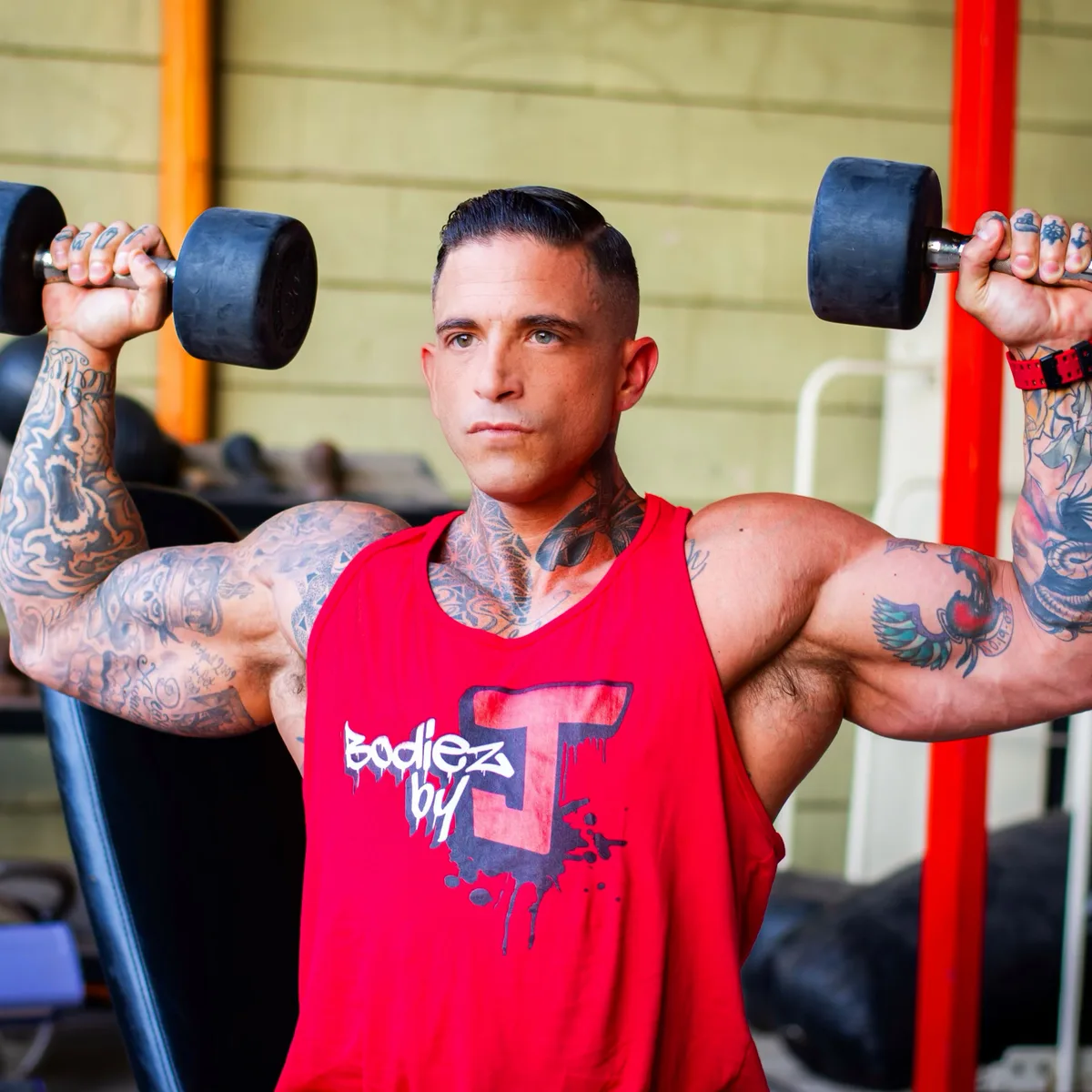
- Seated dumbbell shoulder press: 3 sets of 8–12
- Suitcase carry (one heavy dumbbell): 2–3 walks per side
Day 3 (e.g. Friday)
- Leg press or box squat: 3 sets of 10–12
- Hip thrust or glute bridge: 3 sets of 10–12
- Push-up or flat dumbbell press: 3 sets of 8–15
- Cable or band row: 3 sets of 10–15
- Front-loaded carry (dumbbells or kettlebells at chest height): 2–3 walks
If you have time, add one or two sets of curls, triceps pushdowns or calf raises at the end. They're optional. The five patterns are not.
Joint-friendly swaps
None of these exercises are mandatory. What's mandatory is the pattern. If something hurts, swap it for a variation of the same movement and keep going:
- Knees complain on squats: box squat to a height that feels fine, or a leg press with a shorter range. Lower the box over time.
- Lower back is touchy: use a trap bar or kettlebell instead of a straight bar, and keep the hinge range to where your back stays flat.
- Shoulders hate pressing: use dumbbells or a landmine press with a neutral grip, and favour incline over flat. I go deeper on this in training around a bad shoulder after 40.
- Pull-ups aren't there yet: pulldowns or band-assisted pull-ups build the same pattern.
Mild, short-lived discomfort that eases as you warm up is common. Sharp pain, pain that gets worse during a set, or pain that lingers into the next day is not. Stop that exercise and get it checked by a doctor or physiotherapist. That's their lane, not mine.
How to keep progressing: the double-progression rule
A program only works if it gets a little harder over time. The simplest way I know is double progression:
- Every exercise has a rep range, like 8–10.
- Start with a weight you can lift for the bottom of the range with about two good reps left in the tank.
- Each week, try to add a rep or two at the same weight.
- When you hit the top of the range on all sets with clean form, add the smallest weight jump available and start back at the bottom.
Write every session down. Progress you don't track is progress you can't prove. If you want to know what your working weights should look like, the free 1RM Calculator estimates your max from any set you've already done, without testing a true max — which, after 40, you rarely need to do.
Every 6–8 weeks, back off
Plan a lighter week roughly every six to eight weeks: same exercises, about half the sets, nothing close to failure. Joints and tendons adapt slower than muscle, and an easy week before you need one is cheaper than an injury after you didn't take it.
Mistakes I see most
- Training to failure every set. Leave one to three reps in reserve on most sets. You'll recover faster and train more consistently.
- Skipping the warm-up. Ten minutes now saves weeks off later.
- Changing the program every two weeks. Run it for at least 8–12 weeks. Boring and consistent wins.
- Ignoring food and sleep. Training is the signal; protein and sleep are how you build on it. Start with how much protein a man over 40 really needs.
The bottom line
Three full-body sessions a week, built around squat, hinge, push, pull and carry, is the most reliable starting point I know for men over 40. Pick joint-friendly variations, use double progression, take a lighter week every couple of months, and give it three months before you judge it.
For the whole picture — training, recovery and nutrition together — read the full guide to getting back in shape after 40. If you'd rather have this built around your joints, your schedule and your equipment, with someone checking in every week, that's what I do. Book a free call and we'll talk it through. No pitch, straight answers.
This article is general information, not medical advice. If you have a heart condition, joint injury or other health concern, check with your doctor before starting a new exercise program.
Want this built for you, around your schedule and your body? That’s exactly what my coaching for men over 40 is — a custom plan with weekly check-ins by call or video. See real client results or explore coaching.
This article is general fitness education, not medical advice. Consult your physician before starting any new exercise or nutrition program.
Keep Reading
- How To Get Back In Shape After 40: A Veteran's Guide
- Training Around A Bad Shoulder After 40
- How Much Protein Does A Man Over 40 Need?
FAQ
Is a 3-day full-body workout enough for men over 40?
For most men over 40, yes. Three full-body sessions a week let you train each muscle about three times, which research generally favours over once-a-week training, while leaving a rest day between sessions for recovery. It also comfortably meets public health guidance of muscle-strengthening work at least two days a week.
How long should a full-body workout take after 40?
Plan on about 50 to 60 minutes including a 5 to 10 minute warm-up. Five main exercises of three sets each, with 60 seconds to 2 minutes of rest between sets, fits that window. Optional arm or calf work adds 5 to 10 minutes.
How heavy should I lift on a full-body program over 40?
Choose a weight you can lift for the bottom of the rep range with about two good reps left. Add reps each week at that weight, and only increase the load once you hit the top of the range on every set with clean form. You do not need to test a true one-rep max; a 1RM calculator can estimate it from a normal set.
What if an exercise hurts my joints?
Swap it for a different variation of the same movement pattern, such as a box squat instead of a free squat or a neutral-grip dumbbell press instead of a barbell bench press. Sharp pain, pain that worsens during a set, or pain that lingers into the next day is a signal to stop that exercise and see a doctor or physiotherapist.
Free tools: 1RM calculator · macro calculator · body-fat calculator
■ Free — no card, no catch
Want A Head Start?
Grab the free 5-Day Workout & Meal Plan Sampler — five real training days, a full meal plan, and a grocery list. The same style of programming my clients run.
Get The Free Guide